Anthropic’s IPO Sets Unprecedented Losses and Spending Benchmarks
Anthropic’s public filing shows record quarterly loss, massive future spend and a valuation that could top SpaceX and Aramco.
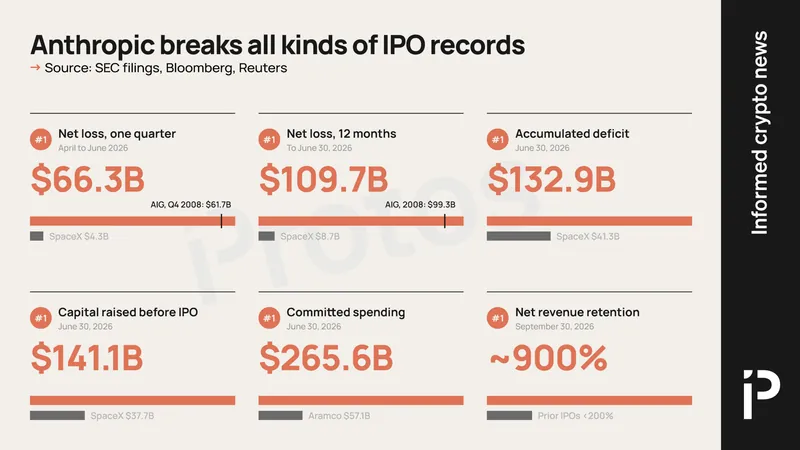
Anthropic’s IPO Filing Breaks Loss Records
Anthropic disclosed a $66.3 billion loss for the second quarter of 2026, surpassing AIG’s $61.7 billion loss in 2008 and establishing a new US corporate record. The loss stems largely from repriced convertible debt and derivative liabilities, which inflated the company’s fair-value adjustments. Over the 12-month period ending June 30, 2026, the loss climbed to $109.7 billion, eclipsing AOL Time Warner’s 2002 loss and AIG’s 2008 loss. The accumulated deficit reported at filing was $132.9 billion, the highest on record; SpaceX’s prior record stood at $41.3 billion.
Capital Flow and Post-IPO Commitments
Anthropic’s prospectus projects $265.6 billion in computational spend over the next few years. This figure dwarfs SpaceX’s disclosed $28 billion of non-cancelable commitments. The spend is earmarked for scaling Claude, the company’s flagship AI model, and for maintaining the infrastructure that supports it. Investors in the IPO will therefore be underwriting a future cash-flow that is heavily weighted toward capital expenditures rather than operating profit.
Valuation and IPO Proceeds
The company’s expected valuation sits at $1.5 trillion, placing it third behind Aramco’s $1.7 trillion and SpaceX’s $1.8 trillion. If Anthropic succeeds in raising $100 billion in proceeds, that figure would surpass the $86.3 billion of stock sold by SpaceX, including underwriter purchases. Private raises have outpaced public markets—OpenAI raised $122 billion in March 2023—but a $100 billion IPO would still be the largest proceeds figure in history.
Revenue Growth and Retention Metrics
Anthropic reported a 1,300% revenue growth in the first half of 2026 versus 2025, the second-highest percentage growth among IPOs after Groupon’s 2,200% at IPO. Revenue per employee reached $6.6 million, bested only by PBF Energy’s 2012 IPO. Net revenue retention was cited at 900%, a figure that surpasses Snowflake’s 150% at IPO. However, the company’s definition of net revenue retention excludes Pro and Max subscribers, allowing the metric to inflate. The omission obscures the churn rate for these high-value customers.
Market Structure Implications
Anthropic’s filing illustrates a new model for AI IPOs: large upfront losses, significant post-IPO capital outlays, and valuations driven by projected future compute needs. The structure places a heavy burden on shareholders to absorb the cost of scaling, while the company gains leverage by securing a valuation that supports its long-term growth narrative. If the company meets its projected proceeds target, it could redefine the capital intensity benchmark for future AI public offerings.
Uncertainties and Caveats
The prospectus cautions that revenue growth may not continue at the current pace. The company also notes that its net revenue retention calculation excludes certain subscriber categories, limiting the metric’s comparability to other IPOs. Investors should weigh the record loss figures against the company’s projected spend and valuation to assess the risk-return profile.
What to Watch
- Whether Anthropic can sustain its projected $100 billion IPO proceeds.
- The actual churn rate for Pro and Max subscribers once the full customer mix is disclosed.
- How the company’s spending trajectory aligns with its revenue growth over the next 12–18 months.
Anthropic’s IPO filing presents a complex tableau of record losses, massive future spend and a valuation that could eclipse the biggest tech IPOs. The structure of the deal signals a shift toward capital-intensive growth models in the AI sector, with investors absorbing significant upfront costs in exchange for a valuation premised on future compute demand.
Related coverage
- Securitize Solana tokenisation drives 38% share fall as market structure shifts
- Tokenized Stocks Face Pushback from Wells Fargo, Cisco, Intuit and Six Other Firms
- KOSPI Drop Exceeds South Korea’s 2025 GDP