MSCI exclusion Strategy could trigger $2.8 B in share sales
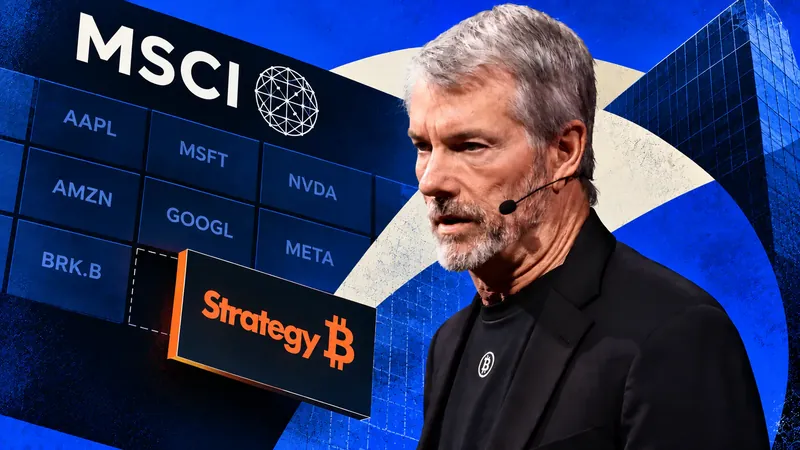
MSCI’s updated criteria may trigger a $2.8 B sell-off of Strategy shares if the Bitcoin-treasury company is excluded from its global indexes.
MSCI exclusion Strategy could trigger $2.8 B in share sales
MSCI announced on 15 October that it would apply a new set of eligibility criteria to its global equity indexes. The criteria focus on operating assets and a series of financial-ratio tests. Companies that fail four of five tests in a single filing period, or fail both of the two most recent annual filings, become candidates for exclusion. Strategy, the Bitcoin-treasury firm founded by Michael Saylor, is on MSCI’s watchlist under the non-operating-company flag. MSCI will publish the list of affected companies on 11 November; any removals would take effect after the 30 November close.
Who Gains Leverage and Who Absorbs Cost?
Passive index-tracking funds constitute the primary demand engine for Strategy shares. When a company is removed from an index, those funds must rebalance, selling the shares they hold. JPMorgan’s 2025 estimate that an exclusion could trigger up to $2.8 B in sales of Strategy shares reflects the scale of that demand. Bloomberg noted that if other index providers followed MSCI’s lead, total selling could rise to $8.8 B. The cost is absorbed by Strategy’s shareholders, who would see a sharp decline in share price as the sell pressure materializes.
Strategy’s preferred-stock amendments, approved by shareholders on 28 October, allow daily dividends on four series. The new dividend schedule would begin on 1 November for STRC and on 1 January 2027 for STRF, STRK and STRD. These amendments are unrelated to the index decision; they simply alter the company’s dividend policy. The MSCI rule change, however, threatens the very source of capital that Strategy relies on to purchase Bitcoin.
Operational Consequences for Strategy
Strategy raises capital through common stock, preferred shares, debt and other instruments. Its preferred securities—STRC and STRK—have already seen declining demand following its exclusion from the S&P 500 in 2025. An MSCI exclusion would likely exacerbate that trend, tightening liquidity for the company’s equity offerings. The company’s ability to finance large Bitcoin purchases would be constrained if passive investors pull out of its shares.
The removal would also trigger a cascade of rebalancing across multiple index families. Funds that track the MSCI Global Investable Market Indexes would sell Strategy shares, while other index providers that adopt similar criteria could follow suit. The resulting sell-off would not require Strategy to liquidate its Bitcoin holdings; the company would simply face a drop in market value and higher cost of capital.
What to Watch Before November 11
- MSCI’s November 11 announcement – The list of excluded companies will be released, confirming whether Strategy is removed.
- Passive fund rebalancing – Observe trading volumes for Strategy shares in the days following the announcement; a spike in selling would validate the $2.8 B estimate.
- Capital-raising activity – Track any new equity or debt issuances by Strategy; a slowdown could signal funding constraints.
- Index provider responses – Monitor statements from other index families; if they adopt similar exclusion rules, the sell-off could widen.
The potential exclusion underscores the importance of index inclusion for companies that depend on passive demand. While Strategy’s preferred-stock amendments provide a new dividend stream, they do not mitigate the risk of losing the steady inflow of capital that index membership delivers. The market will be watching the November 11 decision closely, as it could reshape the liquidity landscape for Bitcoin-treasury firms.
Sponsored: a DeFi value dashboard offers real-time metrics on protocol activity and valuation.
Related coverage
- DeFi Protocol Compliance & Sanctions Matrix
- Bank of Russia crypto exchanges Expand to 17 Firms, Sberbank and VTB Set to Offer Retail Trading
- Tokenized Stocks Face Pushback from Wells Fargo, Cisco, Intuit and Six Other Firms